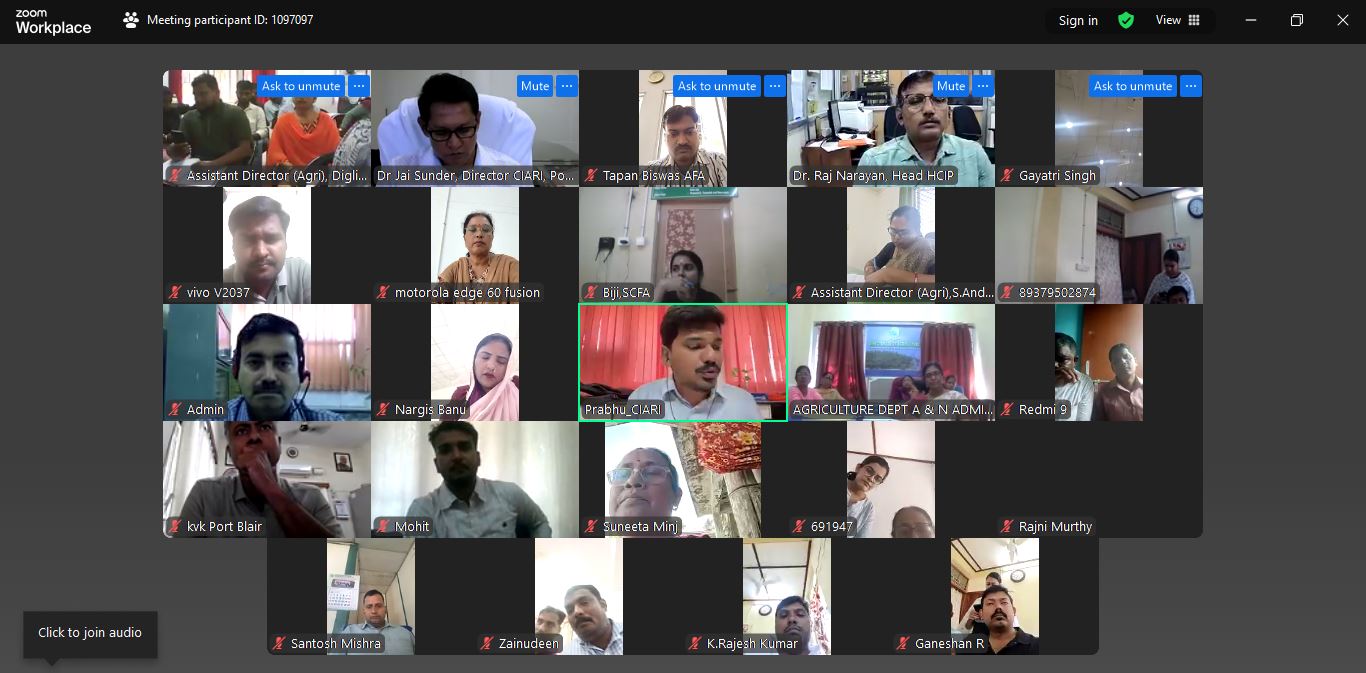


An Online Training Programme on the Packages and Practices of Major Crops for the Andaman and Nicobar Islands was inaugurated today, marking the beginning of a three-day session focused on agricultural advancements and best practices for crop production in the region. The programme, held from December 2nd to 4th, 2025, is aimed at enhancing the knowledge and skills of agriculture officials and field workers in the region. The event was inaugurated virtually by the Director of the Central Island Agricultural Research Institute (CIARI), Sri Vijaya Puram, who delivered the inaugural address, emphasizing the importance of continuous learning and capacity building in agricultural practices to improve crop productivity and sustainability in the Andaman and Nicobar Islands. Mrs. Sri Dewi, Joint Director of Agriculture, highlighted the Environmental issues and region-specific farming practices that are tailored to the unique climatic and geographical conditions of the islands. The Organizing Secretary, Dr. Raj Narayan, Principal Scientist and Head of Horticulture and Crop Improvement, CIARI, welcomed all participants and outlined the importance of the training programme. The scientific team from CIARI, including Dr. P K Singh, Principal Scientist, Dr Y Ramakrishna, Head of KVK, South Andaman, Dr. Santosh Mishra, Head of KVK, Nicobar and Dr. Prabhu P, Scientist, CIARI, took part in the event. The event concluded with the Proposed Vote of Thanks by Dr. P K Singh, Principal Scientist, CIARI, who expressed gratitude to all the dignitaries, participants, and organizing team members for their valuable contributions to the success of the programme. The training programme is expected to enhance the capacity of the agricultural community in the Andaman and Nicobar Islands, enabling them to implement improved crop management techniques, promote sustainable farming practices, and ultimately contribute to the region's agricultural growth.
Dr. Jai Sunder, Director of ICAR–CIARI, emphasized that the challenges posed by the Islands’ climatic conditions can be effectively addressed through the adoption of modern technologies, good agricultural practices, and sound management strategies both at the field and post-harvest stages. He highlighted the crucial role of extension functionaries in ensuring timely and efficient dissemination of these technologies to farmers. Dr. Sunder further noted that such programmes should be designed to be highly interactive rather than purely theoretical, enabling participants to gain practical insights and understanding.