
Director Desk
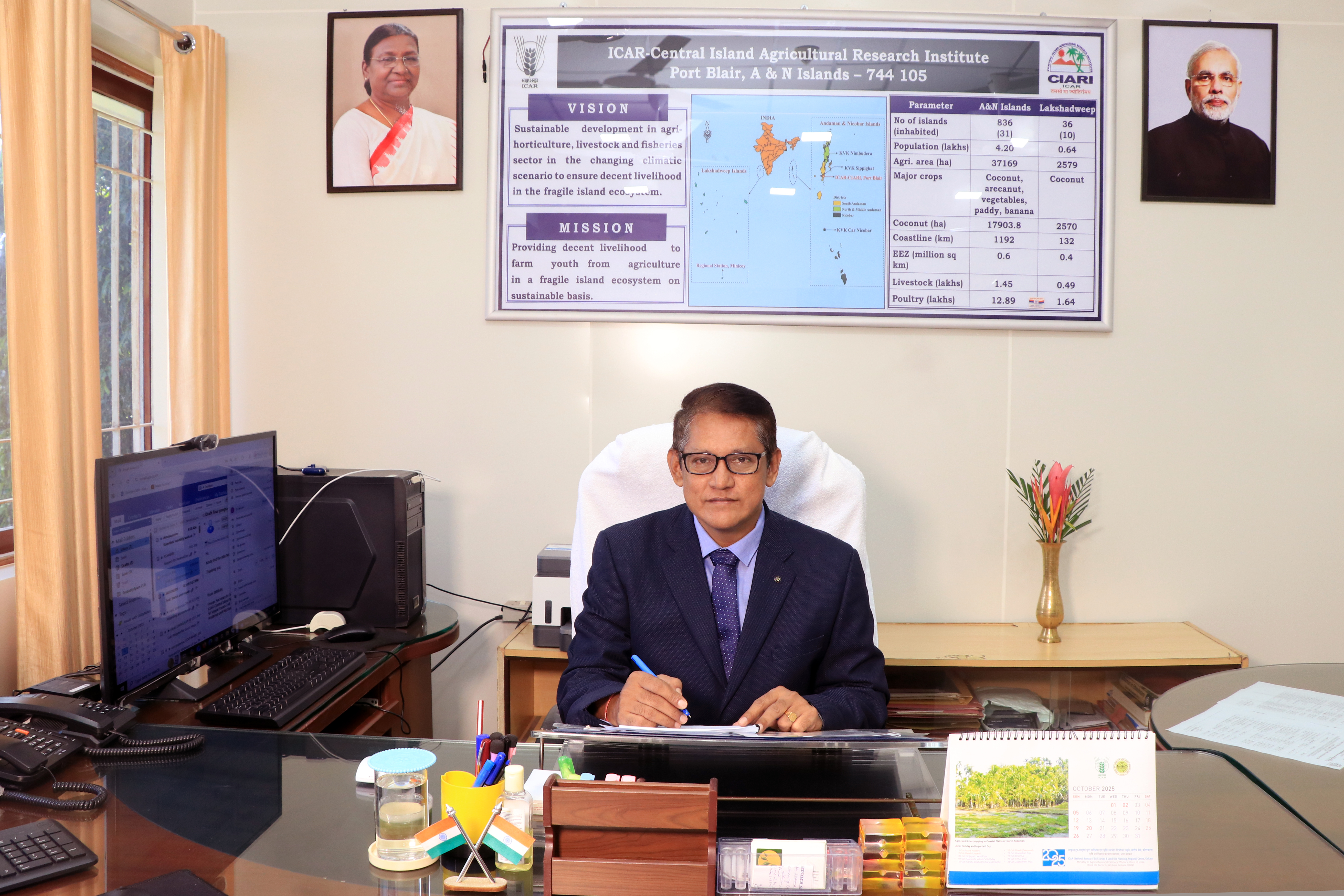
ICAR-Central Island Agricultural Research Institute (CIARI), a unique and premier research institute under the Indian Council of Agricultural Research, was established on 23rd June 1978. CIARI was formed by merging the Regional Research Stations of Central Marine Fisheries Research Institute, Indian Veterinary Research Institute, Indian Agricultural Research Institute, and Central Plantation Crops Research Institute aimed to provide a comprehensive research base for agriculture in the fragile island ecosystem. In 2017, the Regional Station of CPCRI at Minicoy, Lakshadweep, was also integrated with CIARI, extending its research mandate to cover the Lakshadweep Islands. Since its inception, CIARI has been addressing the diverse needs of agriculture, horticulture, livestock, and fisheries through its four research divisions.
Over the years, CIARI has evolved into the only ICAR institute dedicated exclusively to tropical island agriculture. Its focus encompasses conservation and sustainable utilization of natural resources, enhancement of crop, livestock, and fishery productivity, development of biosecurity and animal health technologies, and capacity building and policy support for stakeholders. Research priorities address contemporary challenges, including biodiversity conservation, climate change adaptation, water management, integrated farming systems, waste utilization, and value addition. The institute has also empowered farmers, tribal communities, and rural youth through innovative technology transfer and training programs.
Since its inception, the institute has significantly contributed to bridging the gap between demand and supply through research, extension, entrepreneurship, and skill development. Key accomplishments include recognition of custodian farmers and communities for biodiversity conservation and utilization of indigenous crops and livestock such as Andaman Coconut, Nicobari Aloo, Khoon Phal, chinta Mango, Noni, Khushbayya Rice, Black Burma, Mushley, Nyawin, White Burma, Nicobari Fowl, Nicobari Pig, Andamani Pig, Teressa Goat, Andamani Goat, and Andamani Duck. The institute facilitated the Plant Genome Saviour Community Award to the Karen community for conserving unique rice landraces, and breed conservation awards for Nicobari Pig and Nicobari Fowl to the Tribal Council, Car Nicobar. ICAR-CIARI has been recognized by ICAR-NBAGR, Karnal, for its contributions to biodiversity conservation.
The institute, has developed 45 high-yielding varieties of coconut, noni, rice, pulses, sweet potato, leafy vegetables, brinjal, mushroom, Malabar tamarind, and tejpat, many of which were released for commercial cultivation. Novel and underutilized crops such as Curcuma mangga and Piper pendulispicum have been standardized for cultivation, while valuable germplasm like dwarf arecanut, bacterial wilt-resistant brinjal, and unique Noni accessions have been registered, strengthening the national genetic resource base. In livestock and fisheries, the institute has characterized and registered five indigenous breeds viz. Teressa Goat, Nicobari Pig, Andamani Goat, Andamani Pig, and Andamani Duck. Innovative solutions such as the herbal acaricide (Dweep-Tickure) and Trimodel therapy for hump sore in cattle (Dweep-GauMa Rakshak) have improved animal health and productivity. Mini-incubator technology has boosted rural poultry production, yielding a 2.8-fold increase in chick and duckling availability. In fisheries, ornamental fish larval rearing techniques have been standardized, and new species including Sicyopterus garra, Gymnothorax andamanensis, and Esomus danrica were discovered. At Minicoy, the first Fish Aggregating Device was deployed to support fisher livelihoods.
Technology innovation and commercialization remain central to CIARI’s mandate. Vertical farming models (Dweep-Vertigrow), round-the-year planting material production (Dweep-Goottee 365), integrated coconut–pig farming systems, carp feed mills, herbal formulations, and diagnostic kits are among technologies successfully commercialized. More than 10 patents have been granted for innovations ranging from acaricide formulations to sex determination kits and farm tools, many of which have been licensed to entrepreneurs and start-ups, fostering an ecosystem for agri-innovation.
Biodiversity conservation remains a priority. The institute conserves over 620 accessions of horticultural crops and 208 genotypes of rice and pulses. In-situ conservation initiatives for sea turtles and freshwater turtle habitats in Nicobar Islands have been implemented. Outreach efforts have supplied over 6.8 lakh quality planting materials, 639 quintals of breeder and truthfully labelled seeds, and covered nearly 1,500 ha (30% of the island’s rice area) with CIARI-developed rice varieties. Adoption of pulses and bacterial wilt-resistant brinjal has been widespread.
The institute maintains strong collaborative linkages with ICAR institutes, State Agricultural Universities, line departments, and commodity boards, including West Bengal University of Agriculture & Fisheries Science, Bidhan Chandra Krishi Viswa Vidyalaya, Tamil Nadu J. Jayalalithaa Fisheries University, Odisha University of Agriculture & Technology, Kerala Agricultural University, Acharya N.G. Ranga Agricultural University, Dr. YSR Horticultural University, and Dr. Balasaheb Sawant Konkan Krishi Vidyapeeth. Participation in AICRPs across multiple crops and animals ensures integration with national research priorities.
Technology dissemination is achieved through Kisan Melas, workshops, national and international conferences, and farmer scientist interfaces. Exposure visits for farmers, students, and youth from all three island districts have enhanced awareness, entrepreneurship, and skill development. The institute also leverages media for the dissemination of agricultural technologies and farming information.
Looking ahead, CIARI aspires to emerge as a global hub for tropical island agriculture by 2050. The vision includes climate-smart, sustainable, and resilient farming systems integrating crops, livestock, and fisheries. Advanced tools in genomics, biotechnology, renewable energy, and digital agriculture will address the challenges of remoteness, resource constraints, and climate change. The One Health approach will continue to safeguard fragile island ecosystems.
ICAR–CIARI remains committed in its mission to serve island farming communities with innovative solutions, cutting-edge research, and sustainable technologies. The institute will continue transforming agriculture in the Andaman, Nicobar, and Lakshadweep Islands into a model of resilience, prosperity, and inclusivity, contributing to national food and nutritional security and advancing the vision of a Viksit Bharat by 2047 and beyond.
I am a strong believer in the value of teamwork in science and look forward to working with the entire multidisciplinary scientific team, which includes experts in natural resource management, agriculture, fisheries, and animal science. Our collective goal is to tackle region-specific challenges and foster sustainable development through innovative and collaborative strategies. We can increase productivity, ensure the sustainable use of natural resources, and improve the standard of living for farming and island communities by combining different areas of expertise and sharing knowledge.
Our shared emphasis will be on generating new insights, promoting innovation, and cultivating a culture of professionalism and scientific awareness. Through collaboration and a united commitment, we will endeavor to transform our efforts into substantial actions that yield significant results. These initiatives will not only bring honor and pride to our institution but will also facilitate the personal and professional development of each team member, thereby reinforcing our collective quest for excellence in science and development.