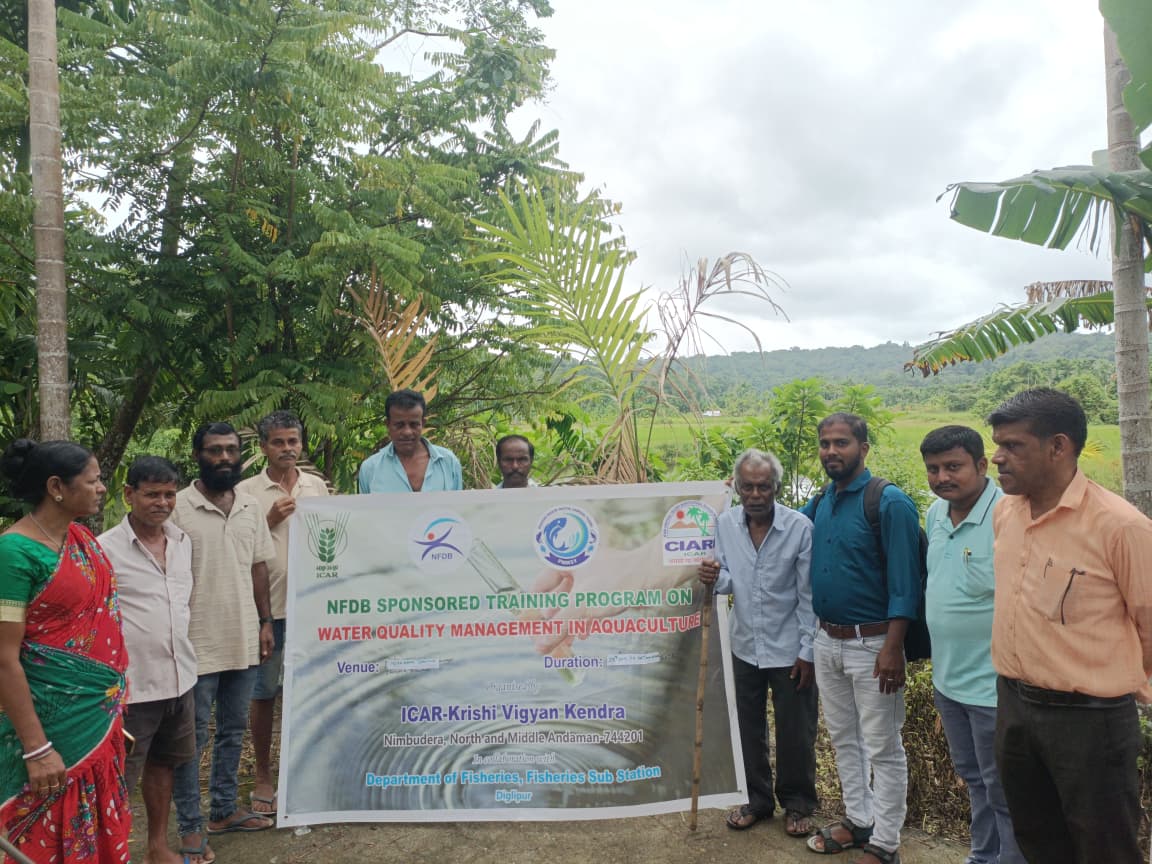


The ICAR-KVK N&M Andaman (CIARI) organized NFDB Sponsored a five-days training
program on“ Water Quality Management in Aquaculture”from October29 th to 2 nd November,
2025, at community hall of Milan Gram of Laxmipur Gram Panchayat, Diglipur.This
initiative was designed to inspire and empower rural farming communities in the district to
engage in freshwater fish farming, enhancing their understanding of water quality
management practices for sustainable aquaculture and broadening economic opportunities.
The training program was inaugurated byDr.V. Damodaran (Sr. Scientist& Head)in the
presence of Shri. Ashim Mistry, PRI member of Laxmipur Gram Panchayat.In his inaugural
address, he highlighted the potential of the aquaculture sector in the North and Middle
Andaman district, particularly with Indian major carp species (Catla, Rohu, and Mrigal), to
improve food security and generate economic opportunities for local communities. He
stressed the need to adopt best practices and advanced technologies to boost productivity and
ensure sustainable growth. Asim Mistry expressed his happiness and lauded the efforts of
KVK and ICAR- CIARI for organizing such training program for the benefit of farming
communities and motivated the farmers and farm women to adopt fish farming practices with
scientific manner in their existing farms to get maximum returns.
During the technical session, Shri Subam Debroy, SMS (Fisheries Science) from ICAR-
KVK, North & Middle Andaman, highlighted the importance of water quality in fish farming.
He explained that dissolved oxygen is crucial for fish respiration, and low levels can cause
stress or death. pH, temperature, and salinity directly affect fish health and growth, while
hardness and alkalinity are essential for skeletal development and pH stability. Ammonia,
nitrite, and nitrate levels can be toxic or interfere with oxygen transport, harming fish. Proper
management of these parameters ensures a healthy pond environment, supports fish growth,
and sustains farm productivity.
Assistant Fisheries Development Officer, Shri Ujjain Dhali and Fisheries Inspector Dr. Vijay
Prasad briefed the participants on sustainable fish farming practices and the benefits of the
PMSSY schemes. They discussed how these schemes help farmers adopt eco-friendly
methods, enhance productivity, and promote responsible aquaculture. The officers also
emphasized the importance of technical guidance and financial assistance under PMSSY for
improving livelihood opportunities in the fisheries sector.
Mr. Rakesh Dawar, SMS (Agronomy), elaborated on the integrated paddy-cum-fish farming
system, where Carps / catfishes can be cultured in flooded paddy fields to optimize resource utilization. The fish feed on insect larvae, weeds, and plankton, reducing pest pressure and
the need for chemical inputs. Their excreta enhance soil nutrient status, thereby improving
paddy growth and overall system productivity.
Later, Shri Subham Debroy and his team conducted hands-on training for the participants,
focusing on effective pond management in aquaculture. They guided the trainees through
practical activities, including measuring dissolved oxygen, pH, temperature, salinity, total
hardness, total alkalinity, ammonia, nitrite, and nitrate levels in aquaculture water samples.
The team also demonstrated various remedies for addressing imbalances in these parameters,
ensuring optimal water quality for sustainable fish farming.During thevaledictory session
certificate were distributed to the traineesby Shri. Sujan Kumar Das, Pradhan of Laxmipur
Gram Panchayat, Diglipur. Earlier,Dr. Vijay Prasad welcomed the gathering and provided an
overview of the training program. The program was organized under the overall guidance of
Dr.Jai Sunder, Director (Act) of ICAR-CIARI, Sri Vijayapuram. About 35 rural youths
participated and benefited from the training.