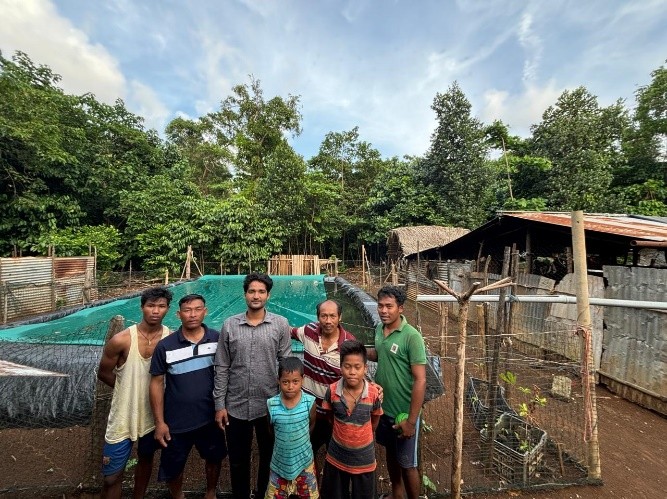

Chowra Island, located in the Nancowry Division of the Nicobar district in the Andaman and Nicobar Islands, is a small inhabited island situated between Teressa Island to the south and Battimalv Island to the north in the Andaman Sea. It is one of the least developed islands in the region, particularly with respect to basic infrastructure such as transportation, market access, communication, and public services. Water resource management on the island is especially challenging due to its geographical and hydrogeological characteristics. The island's inhabitants rely almost entirely on rainwater to meet their domestic, agricultural, and livestock water requirements. Although a few shallow wells are present, the groundwater is predominantly saline, making it unsuitable for drinking and irrigation. Consequently, households harvest rainwater through rooftop collection systems and store it in plastic or steel tanks for use during the dry season. While the construction of additional and improved rainwater harvesting structures and storage facilities could substantially enhance water security, the island's remoteness, limited infrastructure and logistical constraints pose significant barriers to their development and maintenance.
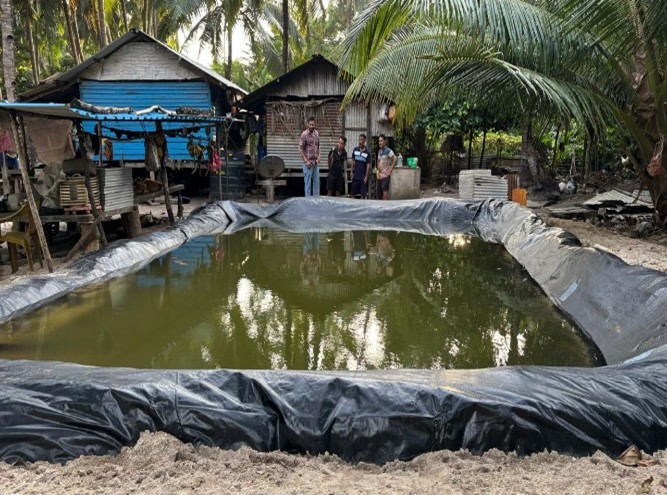
Intervention by ICAR-KVK CIARI Nicobar To address the acute water scarcity on Chowra Island and promote sustainable water resource management, ICAR-KVK, CIARI, Nicobar, with the support of the Tribal Council of Chowra, implemented a demonstration project on the construction of low-cost rainwater harvesting structures. Under this initiative, ten rainwater harvesting ponds, each measuring 7 m × 5 m × 1.5 m, were constructed to capture and store rainwater for agricultural and livestock use. Each pond was lined with High-Density Polyethylene (HDPE) sheets, which serve as an impermeable barrier to minimise seepage losses and improve water storage efficiency. Owing to the island's remoteness and the logistical challenges associated with transporting heavy earthmoving machinery, excavation was carried out manually with the aid of portable drilling machines, despite the presence of hard coral rock deposits in the subsoil. The demonstrated technology is cost-effective, durable, and well suited to the island's unique edaphic and climatic conditions. .
Outcomes and Community Response The demonstrated model received widespread appreciation from the local community for its affordability, simplicity, and ease of replication. Farmers reported immediate benefits in terms of improved access to freshwater for irrigation, livestock, and domestic purposes. Although the ponds were primarily constructed to support agricultural activities, the stored water was also used for domestic purposes. To maintain water quality and ensure its suitability for household use, the ponds were protected from contamination through appropriate fencing and covering measures. Encouraged by the positive outcomes, several farmers expressed their willingness to replicate the model on their own land using locally available labour. Furthermore, its simple design and construction process make it readily replicable by local communities using locally available labour and limited external inputs, thereby enhancing its potential for wider adoption. The demonstrated success also generated considerable community interest, prompting local tribal leadership to formally approach ICAR-KVK CIARI, Nicobar, seeking technical guidance and support for procuring HDPE lining materials to expand the initiative across the island.
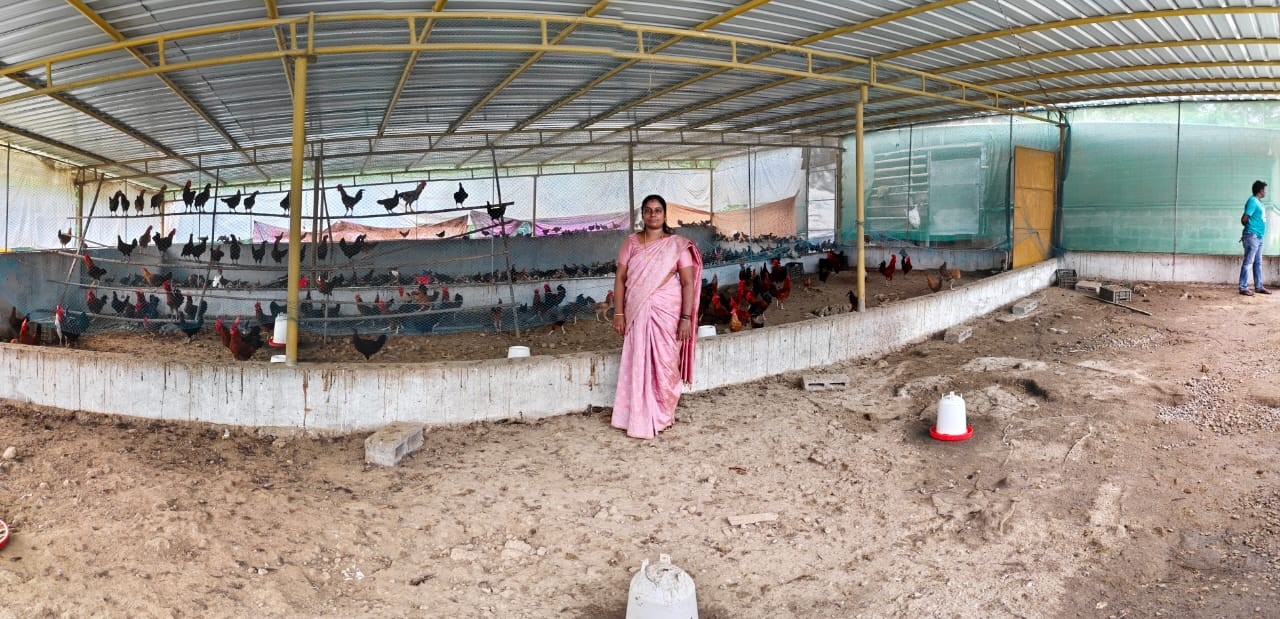
The enterprise now ensures regular production of meat birds, chicks, and table eggs, creating continuous monthly income and employment opportunities. Economic analysis of the scientifically managed rural poultry enterprise revealed that Mrs Rajeshwari presently markets approximately 600 kg of live poultry meat, 600 chicks, and 1,100 table eggs every month. The integrated poultry production system generates an estimated monthly net profit of around Rs. 1.91 lakh with a benefit-cost ratio of 2.02, demonstrating the economic viability and sustainability of scientific rural poultry farming under island conditions. Today, Mrs Rajeshwari stands as an inspiring example of women-led rural entrepreneurship in the Andaman and Nicobar Islands. Her success has encouraged several rural youth and farm women in the region to adopt scientific rural poultry farming as a sustainable business avenue. The success of Mrs Rajeshwari has witnessed that scientific rural poultry farming is a commercially viable sector for self-employment generation for island educated youths.
Source : Dr.T.Sujatha, Dr.Sharath Yeligar, ICAR-Central Island Agricultural Research Institute, Sri Vijaya Puram