
Flame photometer

1.Name of the Instrument: Flame photometer
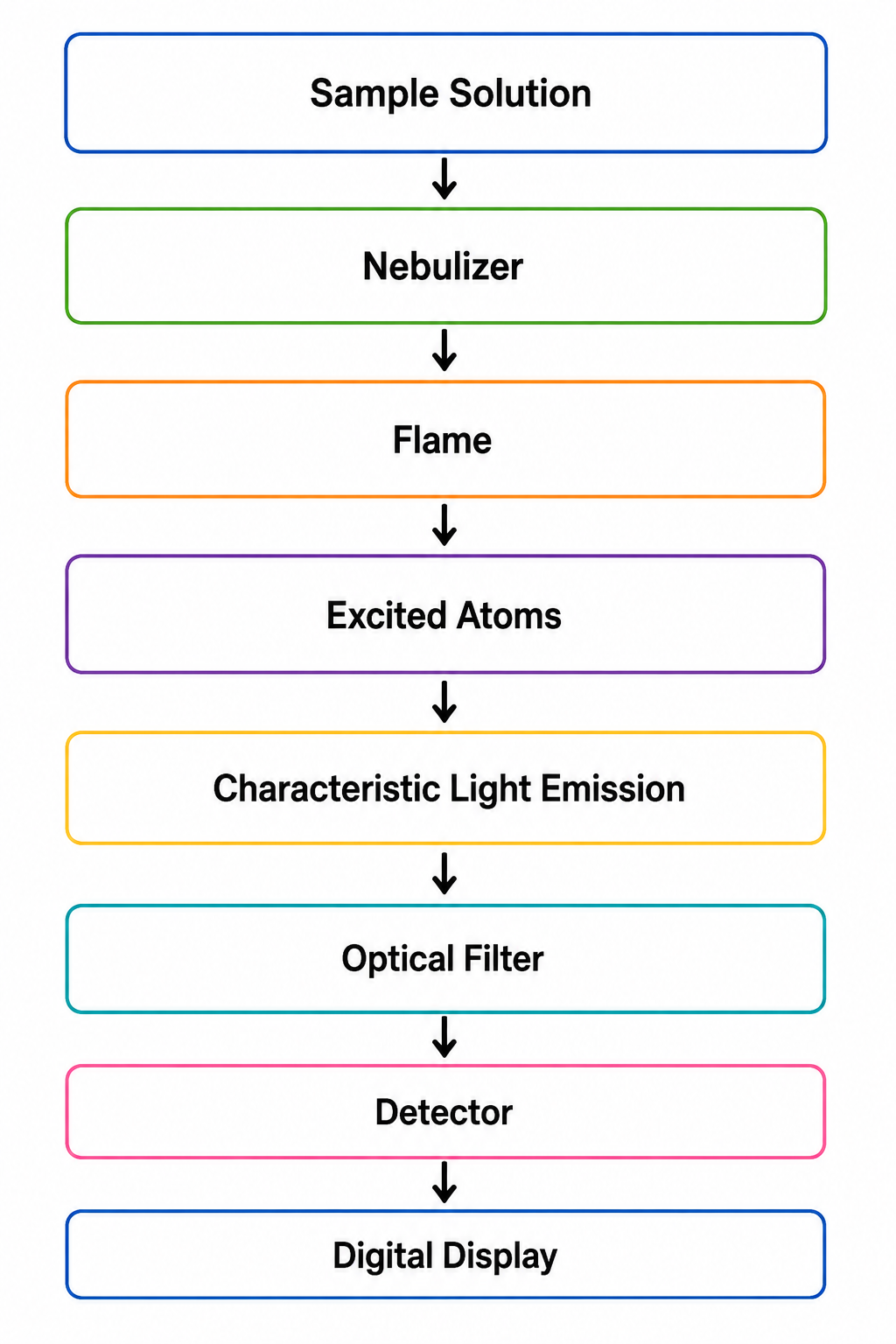
2.Working Principle : The flame photometer works on the principle of flame emission spectroscopy. When a solution containing alkali or alkaline earth metal ions is aspirated into a flame, the atoms become excited. As these excited atoms return to their ground state, they emit light at characteristic wavelengths. The intensity of emitted light is directly proportional to the concentration of the element.
3. Applications and types of studies for which the instrument is used:
• Determination of potassium (K)
• Determination of sodium (Na)
Types of studies:
• Soil fertility evaluation
• Plant nutrient analysis
• Water quality assessment
• Manure and fertilizer quality analysis
• Salinity and sodicity studies
• Crop nutrition research
4. User Instructions :A. • Soil: Representative composite sample.
• Plant: Oven-dried plant material.
• Water: Clean polyethylene bottle.
B. Preparation: • Soil: Air dried, ground and passed through 2-mm sieve.
• Plant: Digested using acid digestion.
• Water: Filter if turbid.
C. Quantity
• Soil: 250–500 g
• Plant: 50–100 g
• Water: 250 mL
4. Submission requirements:• Label sample properly.
• Mention crop, location, and sampling depth.
• Submit request form with required details.